SEO Services for Home Service Businesses: Get More Calls and Jobs

Home service companies do not need vague traffic. They need booked estimates, ringing phones, filled schedules, and steady work that pays well. That sounds obvious, yet many plumbers, HVAC contractors, electricians, roofers, landscapers, and cleaning companies still get sold SEO Services as if rankings alone are the goal. They are not.
A first-page keyword that never turns into a call has limited value. A local page that drives six qualified leads a month can be worth far more than a broad term with hundreds of visits from people outside your service area. In this market, the difference between good SEO and expensive busywork usually comes down to one thing: whether the strategy is built around how homeowners actually search, compare, and choose.
People looking for home services are often in a hurry. Their water heater failed. Their AC stopped cooling. A tree came down after a storm. Even when the need is not urgent, the buying cycle is still practical. They want to know whether you SEO Services serve their town, whether you are credible, whether you answer the phone, and whether they can trust someone in their home. Search visibility matters, but trust signals and local relevance matter just as much.
What SEO looks like when it is built for calls, not vanity metrics
For a home service business, search engine optimization is not just about pushing a homepage upward. It is the combined work of making your company visible in the map results, improving the pages that target real services and service areas, tightening the technical foundation of the site, and strengthening off-site signals that tell Google you are a legitimate local business.
When this is done well, a few patterns usually show up. The Google Business Profile starts appearing more often in maps. Service pages begin ranking for phrases tied to buyer intent, such as “water heater repair near me” or “emergency electrician in Plano.” Organic traffic becomes more local and more relevant. Call volume rises, often unevenly at first, then more steadily as more pages mature.
The strongest campaigns also respect the economics of the trade. If your average ticket for drain cleaning is modest, but your HVAC replacements bring in serious revenue, those jobs should not be treated the SEO Services same way in the SEO plan. I have seen home service sites pour effort into low-value keywords while high-margin services had no dedicated page at all. That is a planning error, not a content error.
Why home service SEO is different from general local marketing
Home service businesses operate inside tight geographic boundaries. A law firm may draw from an entire metro area for one high-value case. A garage door company cannot profitably drive ninety minutes each way for a standard repair unless the ticket justifies it. That changes how SEO Services should be structured.
The website needs to reflect the actual operating footprint, not a fantasy map. If you truly serve twelve towns well, you can build quality local relevance across those areas. If you create fifty weak city pages for places you barely visit, the site starts to read like spam. Google has become much better at spotting that pattern, and homeowners can sense it too.
Urgency also changes behavior. In many industries, users browse, read, compare, then return later. In home services, a large share of users want an answer now. That means title tags, page copy, reviews, mobile usability, and click-to-call functionality all influence results. You are not just competing to rank. You are competing to be chosen in under a minute.
Seasonality adds another layer. HVAC companies feel the rush in early summer and deep winter. Roofers see spikes around storms. Pest control can swing with weather and local infestations. A smart SEO program plans ahead of those demand curves rather than reacting after the phones slow down.
The local search results that matter most
Most owners think of SEO as the blue links in Google. For home service businesses, the map pack often matters even more. Those top map listings absorb a huge share of high-intent local clicks and calls. If your company is invisible there, you are leaving revenue on the table.
Your Google Business Profile deserves the same level of care as your website. Categories need to match core services. Service areas should reflect real operations. Photos should show actual jobs, trucks, staff, and branded equipment where possible. Reviews need active management, not just passive hope. Questions and answers, business hours, and updates all contribute to the quality of the listing.
I have watched small operators with average websites outperform bigger competitors because their local presence was cleaner and more trusted. They had more recent reviews, more specific service descriptions, and clearer evidence that they were active in the community. They were not gaming the system. They were simply giving Google and potential customers more confidence.
The website still matters because it supports the map listing. A well-optimized Google Business Profile connected to a weak, thin, confusing site can hit a ceiling. Search engines want consistency. So do users.
What good SEO Services usually include
Not every provider uses the same process, but solid SEO Services for home service businesses usually cover a handful of core areas:
- local keyword research tied to real services, towns, and buyer intent
- service page and location page optimization based on actual demand
- Google Business Profile management, including review and listing improvements
- technical SEO, such as mobile performance, indexing, site structure, and schema
- link and citation work that strengthens local authority without spam
That list sounds straightforward. The hard part is execution. Plenty of agencies can produce reports. Far fewer can decide which services deserve dedicated pages, which nearby towns justify custom content, or whether your weak rankings are caused by poor authority, weak content, bad internal links, or a Google Business Profile problem.
Service pages are where many home service sites win or lose
A common problem in this space is the “all services on one page” setup. The site has one generic services page with short blurbs for AC repair, furnace installation, duct cleaning, thermostat replacement, and heat pump service. That may be easy to build, but it gives search engines very little to work with.
Each core revenue service should usually have its own page, written with enough detail to answer real questions and demonstrate expertise. That does not mean stuffing keywords into awkward copy. It means building pages that align with actual search intent.
Take water heater work as an example. Repair and replacement are different searches with different motivations. Tankless and standard systems often deserve their own treatment. An emergency call at 9 p.m. Is not the same as a homeowner researching replacement options over the weekend. A strong site reflects those differences.
The same principle applies to service areas. If you serve Charlotte and Matthews, those pages should not be carbon copies with the city name swapped out twenty times. The better pages mention what is actually relevant, common housing stock, local neighborhoods if appropriate, permit or inspection expectations when relevant, travel and scheduling realities, and the specific services most requested there. Thin duplication rarely performs for long.
Reviews do more than build trust
Homeowners read reviews to reduce risk. Google reads review patterns as one among many local relevance and trust signals. That is why review strategy belongs inside SEO, not off to the side.
Volume matters, but quality and recency matter too. A business with 180 reviews from three years ago does not look as alive as a business with 95 reviews and fresh feedback every week. Service-specific language helps as well. When customers naturally mention “panel upgrade,” “same-day AC repair,” or “roof leak after storm,” those details support relevance and reassure future buyers.
Requesting reviews should be part of the job closeout process. The best companies make it easy. The technician finishes the work, the office follows up, and the customer receives a simple link. There is no need to overcomplicate it. The key is consistency.
Replying to reviews is often overlooked. A thoughtful response, especially to mixed feedback, demonstrates professionalism. It also gives you a chance to reinforce service terms naturally and show that a real business is paying attention.
Content that sounds like the field, not a generic marketing template
Homeowners can tell when website copy has no connection to real work. So can experienced marketers. Vague claims like “we provide quality solutions for all your needs” do not help rankings or conversions. Specificity does.
Good content for home service SEO often includes practical details that only come from experience. A plumber might explain the difference between a temporary drain clearing and a full line issue. An HVAC company might describe why short cycling points to more than one possible cause. A roofer might outline what homeowners should document after wind damage before repairs begin.
That kind of writing earns trust because it sounds grounded. It also attracts better leads. People who understand your process a little better before calling are easier to qualify and easier to close.
One contractor I worked with had a page about sewer line replacement that consistently pulled leads, even though the total search volume was not huge. The reason was simple. The page answered painful, expensive questions clearly, including warning signs, trenchless versus traditional methods, and what affected cost ranges. Users landed there, felt informed, and called. That is what useful content looks like in practice.
Technical SEO should support the sale, not become a distraction
Some technical work is essential. Home service sites need to load quickly on mobile devices, especially over spotty cellular connections. Pages should be indexable. Internal links should help Google and users move from broad service categories into detailed pages. Structured data can clarify business information. Image sizes should be controlled. Duplicate pages and crawl waste should be cleaned up.
Still, technical SEO is often oversold to small local businesses. If your site is reasonably healthy but has weak service pages, few reviews, and almost no local authority, shaving half a second off page speed probably will not transform lead flow by itself. It matters, but it is not magic.
The right way to think about technical SEO is as a foundation. It removes friction. It rarely replaces strong local relevance and trust. Any agency that spends months talking only about metadata and audits while ignoring service-page strategy is likely avoiding the harder work.
Links and citations still matter, but quality beats volume
A home service business does not need hundreds of random backlinks. It needs credible signals from places that make sense. Local chambers, trade associations, relevant directories, neighborhood sponsorships, supplier relationships, local news mentions, and community involvement can all help. The goal is not to manufacture authority out of thin air. It is to reflect real-world legitimacy online.
Citations also matter for local consistency. Your name, address, and phone number should align across major platforms. Inconsistent listings can muddy trust signals, especially when older addresses, tracking numbers, or duplicate profiles are floating around.
This is one area where shortcuts cause damage. Cheap link packages and mass directory blasts often create noise rather than value. Home service brands live or die on trust. Spammy tactics work against that.
How long SEO takes to produce real jobs
Owners understandably want a clear timeline. The honest answer is that results vary based on competition, service area, website age, existing authority, and how much foundational work is needed. A business with a clean website, strong reviews, and decent local recognition may see measurable movement in a few months. A newer company in a competitive metro area may need longer.
The bigger point is that SEO is cumulative. Paid ads stop when the budget stops. Organic growth tends to build over time. Once a service page earns trust and rankings, it can keep producing leads with far lower marginal cost than paid acquisition. That is why established home service companies often rely on both channels. PPC helps fill demand quickly. SEO improves long-term efficiency and resilience.
If someone promises dominant rankings in thirty days across every target city, be cautious. Local SEO can move faster than national campaigns, but durable gains usually come from steady execution, not stunts.
Measuring success the right way
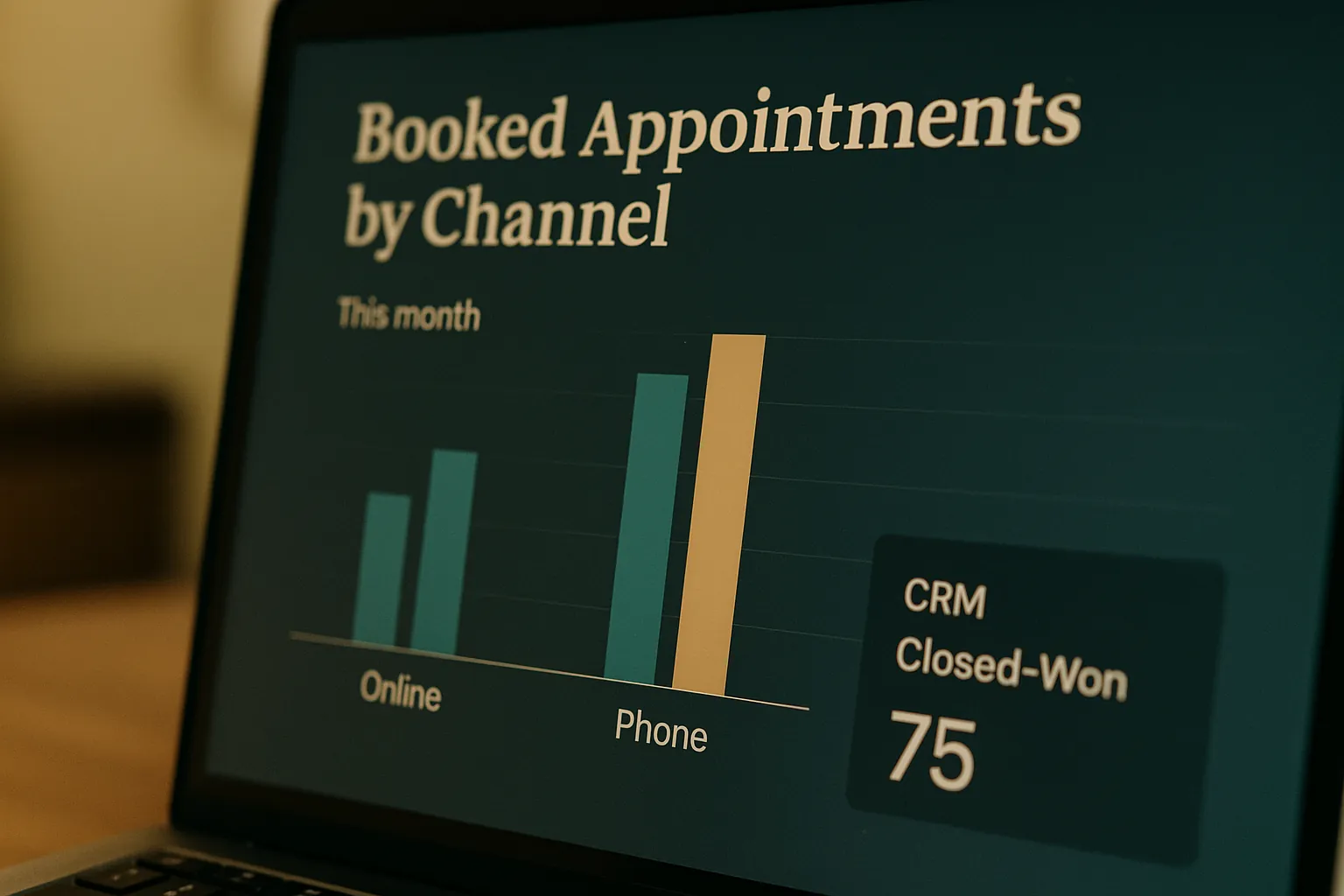
Traffic is a supporting metric. Rankings are a directional metric. The numbers that matter most are leads, booked jobs, cost per lead, close rate, and revenue by service line.
A useful reporting setup connects SEO activity to business outcomes. Which pages drive calls? Which service keywords convert into estimate requests? Which towns produce the best customers? Are you attracting maintenance calls when you really want replacements, or vice versa? That level of visibility changes the conversation from “we gained 18 percent more sessions” to “drain line pages improved, but mini-split pages are bringing in higher-value work.”
Here are the metrics worth watching most closely:
- calls and form submissions from organic search and Google Business Profile
- rankings for service-plus-location keywords with clear buyer intent
- local visibility in the map pack for core services
- conversion rates on major landing pages
- revenue trends tied to organic leads, when tracking allows it
Even imperfect attribution is useful if it is interpreted carefully. Not every call will be tagged perfectly. Some customers see you in search, then return later by branded search or direct traffic. What matters is building a reasonable picture of performance over time.
Choosing the right SEO partner for a home service business
The wrong provider usually sounds polished and vague. The right one tends to ask operational questions. Which services produce the best margins? Which towns are easiest to serve profitably? What does your team close well? Do you want more emergency work, replacement jobs, maintenance agreements, or all of the above? That is how strategy starts.
A good agency or consultant should also be willing to challenge assumptions. If your company insists on targeting distant cities that rarely convert profitably, someone experienced should say so. If your website hides the phone number, has weak trust signals, or sends traffic to a homepage instead of the relevant service page, that should be addressed before anyone boasts about impressions.
Ask to see how they think, not just how they design dashboards. You want a partner who understands the difference between a page that ranks and a page that books work.
Common mistakes that quietly suppress lead volume
The frustrating part about home service SEO is that businesses can do many things half-right and still underperform. Often the issue is not one dramatic failure. It is a stack of small problems.
A company may have solid reviews but no dedicated location pages. It may have good service pages but poor mobile usability. It may rank reasonably well but route every organic visitor to a generic contact page with no service context. It may earn traffic from blog posts that homeowners read out of curiosity, while the pages for high-value services remain thin and underbuilt.
Another frequent issue is misalignment between field reality and website messaging. If your crews do excellent panel upgrades but the website barely mentions them, the market cannot find you. If your office only services certain ZIP codes quickly, but your site claims broad coverage with no nuance, you attract low-fit calls and waste dispatch time.
Small repairs here can produce large business effects. I have seen call volume improve simply by tightening service-area messaging, upgrading weak service pages, and making the phone number more prominent on mobile. No miracle. Just better alignment.
The businesses that benefit most from SEO Services
Almost any local home service company can benefit from stronger organic visibility, but the biggest gains often show up in businesses that already have operational discipline. They answer the phone. They follow up on missed calls. They ask for reviews. They show up on time. They have enough capacity to handle new demand without delivering a poor customer experience.
SEO amplifies what is already there. If the business struggles to convert leads, fix that too. More traffic does not solve a broken sales process. It just exposes it.
For established operators, SEO can reduce dependence on lead marketplaces and costly pay-per-click campaigns. For newer companies, it can build a stable acquisition channel that compounds month after month. Either way, the value comes from attracting homeowners at the moment they need help and giving them a clear reason to call you first.
The best SEO Services for home service businesses are not really about rankings in isolation. They are about market coverage, trust, and lead quality. They help the right customers find you in the right places, then make it easy for those customers to take the next step. When that system is set up properly, the result is not just more website visits. It is more calls, more booked jobs, and a stronger business that is less vulnerable to the ups and downs of paid advertising.
Magister Digital AI
1135 Garnet Ave #13, San Diego, CA 92109
+16193300953
FAQ About SEO Services
What do SEO services include?
SEO services can include technical site reviews, keyword and search-intent research, content improvement, internal linking, local optimization, structured data, and performance reporting. The exact scope should reflect the business, market, and goals.
How long does SEO take to show results?
Timing varies with the website's current condition, competition, and scope. Technical improvements may show movement sooner, while competitive content and authority work often require several months of consistent effort.
Do SEO services include local SEO?
They can. Local SEO commonly covers Google Business Profile optimization, accurate business citations, local schema, reviews, and service-area or location content when those elements are relevant.
How should SEO performance be measured?
Useful measures include qualified organic traffic, calls, form submissions, booked appointments, revenue influence, and visibility for searches that matter to the business. Rankings alone do not show the full outcome.